Discovering a puncture does not always mean you need a completely new tyre. Some punctures can be repaired safely, while others require the tyre to be replaced.
The correct solution depends on the position and size of the puncture, the condition of the tyre and whether it has been driven while underinflated or flat. A tyre must be removed from the wheel and carefully inspected before a permanent repair can be approved.
If you have a punctured tyre in Poole, Bournemouth or the surrounding Dorset areas, Tyres Direct Mobile Tyres can come directly to your home, workplace or roadside location and assess the safest solution.
When Can a Punctured Tyre Be Repaired?
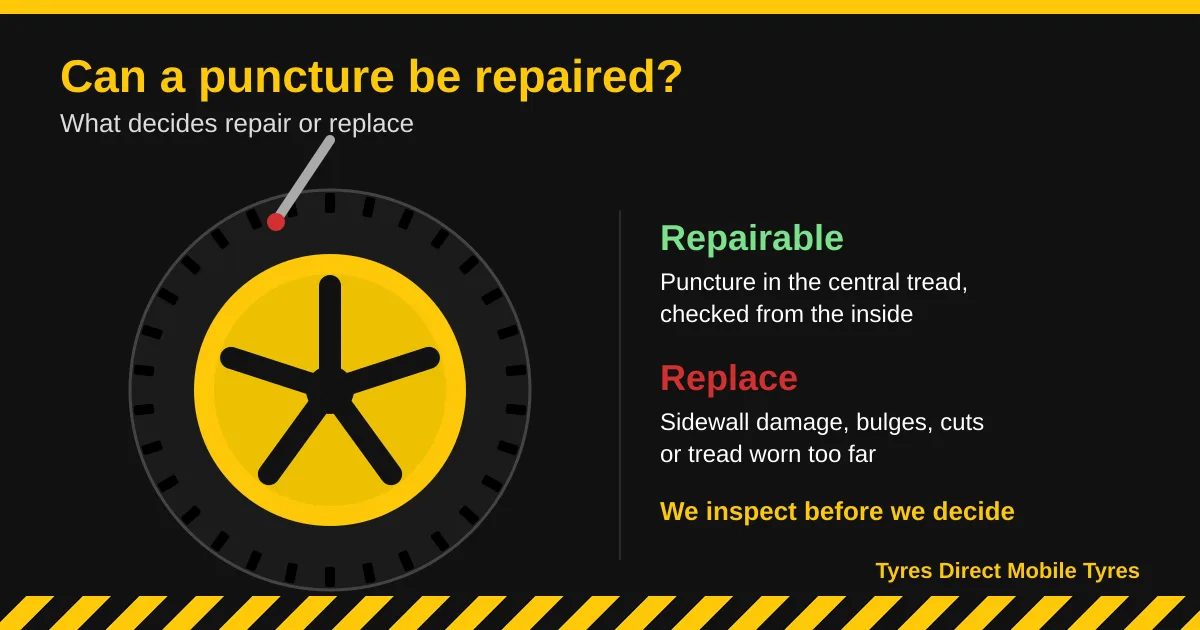
A puncture may be repairable when it is small, located within the appropriate part of the main tread and has not caused additional internal or structural damage.
Before approving a repair, a tyre technician will consider:
- The position of the puncture
- The size and type of damage
- The tyre’s remaining tread depth
- The tyre’s age and general condition
- Whether it has previously been repaired
- Whether it was driven while flat
- Whether its internal structure has been damaged
According to TyreSafe’s puncture-repair guidance, permanent repairs should be completed by a tyre specialist in accordance with the relevant British Standard. The tyre must be removed from the wheel so that both its internal and external condition can be examined.
Where Is the Repairable Area of a Tyre?
The location of the puncture is one of the most important considerations. Repairs are normally restricted to the central area of the tread, sometimes referred to as the minor repair area.
A puncture on or close to the sidewall cannot normally be safely repaired. Unlike the main tread, the sidewall constantly flexes as the tyre rotates and supports the vehicle’s weight. A repair in this area may not provide a safe or lasting solution.
TyreSafe provides further information about the location and condition requirements for puncture repairs.
When Does a Punctured Tyre Need Replacing?
A punctured tyre will usually need to be replaced when the damage cannot be repaired safely or the tyre is already in poor condition.
Replacement may be necessary when:
- The puncture is within the sidewall or shoulder area.
- The tyre has a cut, tear or visible bulge.
- The internal cords or structure are damaged.
- The tyre has been driven while flat.
- The tread is below the legal minimum.
- The tyre has excessive cracking or deterioration.
- The puncture is too large for an approved repair.
- There are multiple punctures or unsuitable previous repairs.
A technician should make the final decision after inspecting the entire tyre. Damage hidden inside the tyre may not be visible while it remains fitted to the wheel.
Can You Repair a Sidewall Puncture?
A puncture or cut in the sidewall generally cannot be repaired safely. The sidewall experiences substantial movement and flexing whenever the vehicle is driven. It also plays an important role in supporting the vehicle and maintaining the tyre’s shape.
Sidewall damage can weaken the tyre’s structure and increase the risk of sudden failure. If you notice a cut, bubble or puncture in this area, avoid driving the vehicle and arrange a replacement.
Can You Drive With a Nail in Your Tyre?
A nail or screw may temporarily remain lodged in the tyre and slow the loss of air, but that does not mean the vehicle is safe to drive normally.
Do not remove the object yourself. Removing it can cause the tyre to lose pressure much more quickly. Check the pressure if it is safe, avoid unnecessary driving and arrange a professional inspection.
If the tyre is visibly flat, the vehicle feels unstable or the pressure is dropping rapidly, stop driving. Continuing can damage the tyre’s internal structure and wheel, potentially turning a repairable puncture into a required replacement.
Our guide on what to do if you get a flat tyre provides additional advice for safely handling a roadside tyre problem.
Are Emergency Tyre Repair Kits Permanent?
Many newer vehicles include an emergency sealant and compressor kit instead of a spare wheel. These kits are designed to provide temporary assistance for certain minor punctures, allowing the vehicle to reach a safe location or tyre specialist.
A sealant kit should not be considered a permanent repair. It may not be suitable when:
- The sidewall is damaged.
- The wheel rim has been damaged.
- The tyre has been flat for an extended period.
- The puncture is too large.
- The tyre has come away from the wheel rim.
Always follow the instructions supplied with your vehicle and repair kit. Observe any stated speed and distance restrictions and arrange a professional inspection as soon as possible.
Why Should a Tyre Be Removed Before Repair?
Inspecting only the outside of a punctured tyre does not reveal its complete condition. Removing the tyre allows the technician to check for internal damage caused by the puncture, heat or driving with insufficient pressure.
A proper inspection can identify:
- Damaged internal cords
- Signs that the tyre was driven while flat
- Secondary punctures
- Deterioration around a previous repair
- Damage to the inner lining
- Problems with the wheel or valve
This is why permanent tyre repairs should be completed by an appropriately trained specialist rather than relying on an external plug as a long-term solution.
How Can Mobile Tyre Fitting Help?
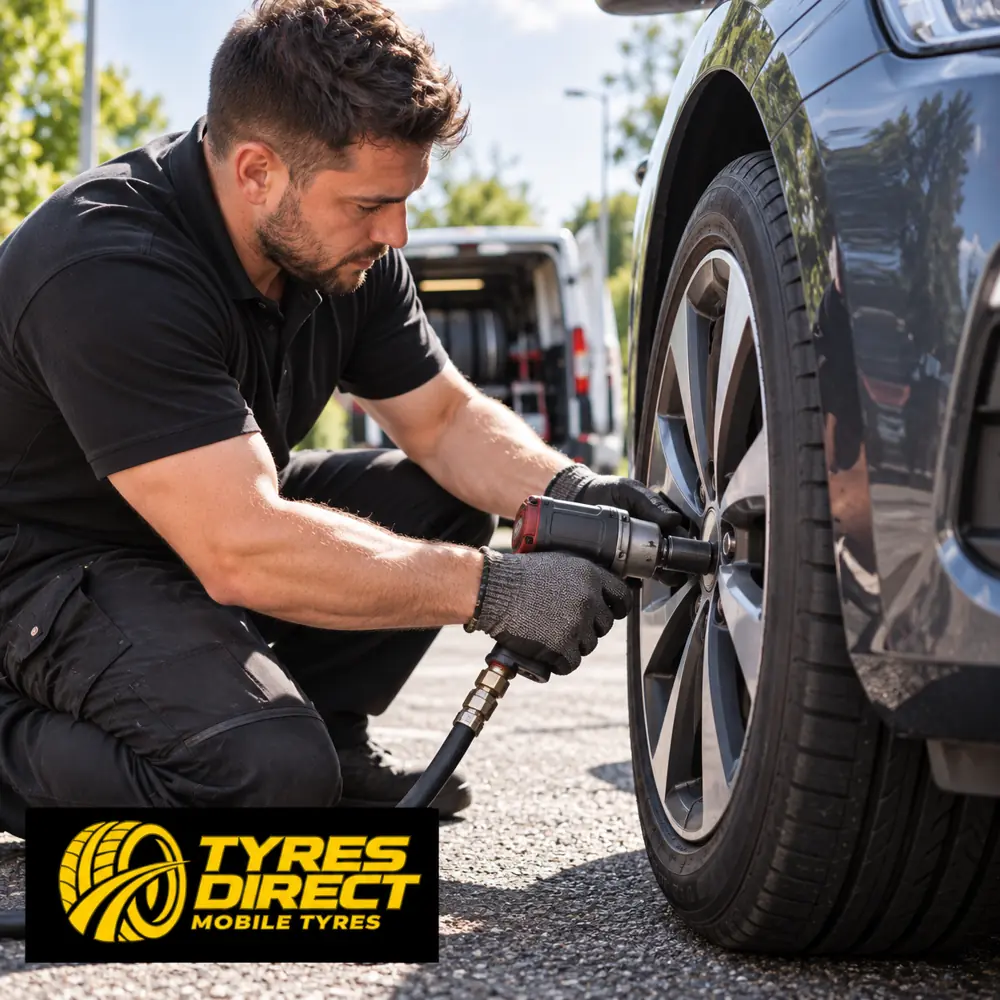
A puncture may leave your vehicle unsafe to drive to a garage. Mobile tyre fitting brings the necessary expertise and equipment directly to your location.
This service can help when your vehicle is:
- On your driveway
- Parked at work
- Stranded at the roadside
- In a public car park
- Unable to reach a garage safely
When contacting a mobile tyre fitter, provide your vehicle registration, location, contact number and tyre size if you can read it safely. The tyre size is printed on the sidewall and usually looks similar to 205/55 R16.
Request Mobile Tyre Assistance in Poole or Bournemouth
If you have discovered a puncture, avoid guessing whether the tyre is safe to repair. A professional inspection will establish whether an approved repair is possible or a replacement is required.
Tyres Direct Mobile Tyres provides reliable mobile tyre assistance across Poole, Bournemouth, Dorset and the surrounding areas. We come directly to your location, provide a clear quote and help get your vehicle safely back on the road.
Contact Tyres Direct Mobile Tyres today and provide your vehicle registration, tyre size and current location to request assistance.