
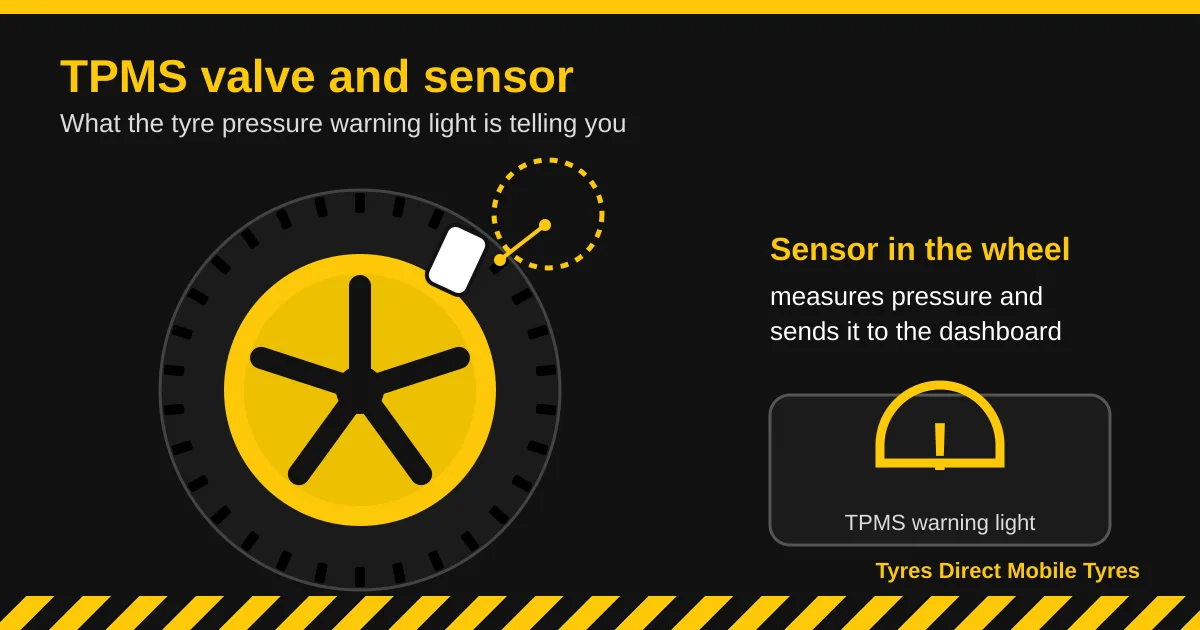
If a small yellow tyre-shaped warning light has come on in your dash, your car is telling you that one or more tyres has low pressure. That light comes from the tyre pressure monitoring system, usually shortened to TPMS. The sensors sit inside the wheel, and they are attached to the valve, which is why valve and sensor work often goes together with a tyre change.
What is a TPMS sensor?
Tyre pressure monitoring systems have been fitted to new cars sold in the UK and the EU since late 2014, so if your car is newer than that it almost certainly has one. There are two types:
- Direct TPMS uses a small battery-powered sensor in each wheel that measures pressure (and often temperature) and sends it to the car.
- Indirect TPMS has no sensor in the wheel. It uses the car’s ABS wheel-speed sensors to spot a tyre that is turning faster because it has lost pressure.
Direct systems are the ones that involve valves and sensors at the tyre fitter. Indirect systems usually need a reset after you correct the pressures, and your handbook will tell you how.
Why does the valve or sensor need replacing?
- The sensor battery runs flat. The battery is sealed inside the sensor, and sensors commonly last somewhere around five to ten years depending on the car and how much you drive.
- Corrosion or damage. Valve stems and seals age, especially in winter when roads are salted. A leaking valve can look like a slow puncture.
- It was damaged during a tyre change. This is a reason to use a fitter who is used to TPMS wheels.
- The sensor needs to be matched to the car. After a sensor is replaced, some cars need it programmed or relearned.
Signs the valve or sensor may be the problem
- The TPMS warning light stays on after you have checked all four tyres and set them to the correct pressure.
- The light flashes for about a minute when you start the car, then stays on. On many cars this points to a fault in the system rather than low pressure.
- A tyre keeps losing pressure slowly even though there is no nail or damage you can find.
- The pressure shown on your dash does not match what you measure at the tyre.
Check the pressure first. Our guide to checking your tyre pressure takes a couple of minutes, and a light that goes off after you inflate the tyre was probably doing its job.
Should you replace the valve when you fit new tyres?
It is common practice to fit a new valve or valve service kit when a tyre is replaced, because the rubber seals have a limited life and are easy to replace while the tyre is off the wheel. On a TPMS wheel the service kit usually means new seals, a nut and a cap rather than a new sensor, but a sensor with a flat battery cannot be fixed that way and has to be replaced.
Can this be done at your home or work?
Usually yes. A mobile fitter can replace a valve or look at a TPMS fault where the car is parked, subject to the right parts being available for your car. Give us your registration and tell us what the dash is showing, and we can say what is likely to be needed. If you need a tyre replaced or a puncture repaired at the same time, we can look at that on the same visit. Mobile tyre fitting in Bournemouth and Poole is what we do.