Your tyres are the only parts of your vehicle that remain in direct contact with the road. Their condition can affect steering, braking, fuel efficiency and overall road safety. Unfortunately, tyre damage is not always immediately obvious.
Recognising the warning signs early can help you avoid a breakdown or unexpected flat tyre. If your tyres are damaged or excessively worn, Tyres Direct Mobile Tyres can provide professional mobile tyre fitting at your home, workplace or roadside location across Poole, Bournemouth and the surrounding Dorset areas.
1. Your Tyre Tread Is Too Low
Tyre tread helps your vehicle maintain contact with the road, particularly during wet weather. As the tread wears down, the tyre becomes less effective at clearing water from beneath it. This can reduce grip and increase the risk of aquaplaning.

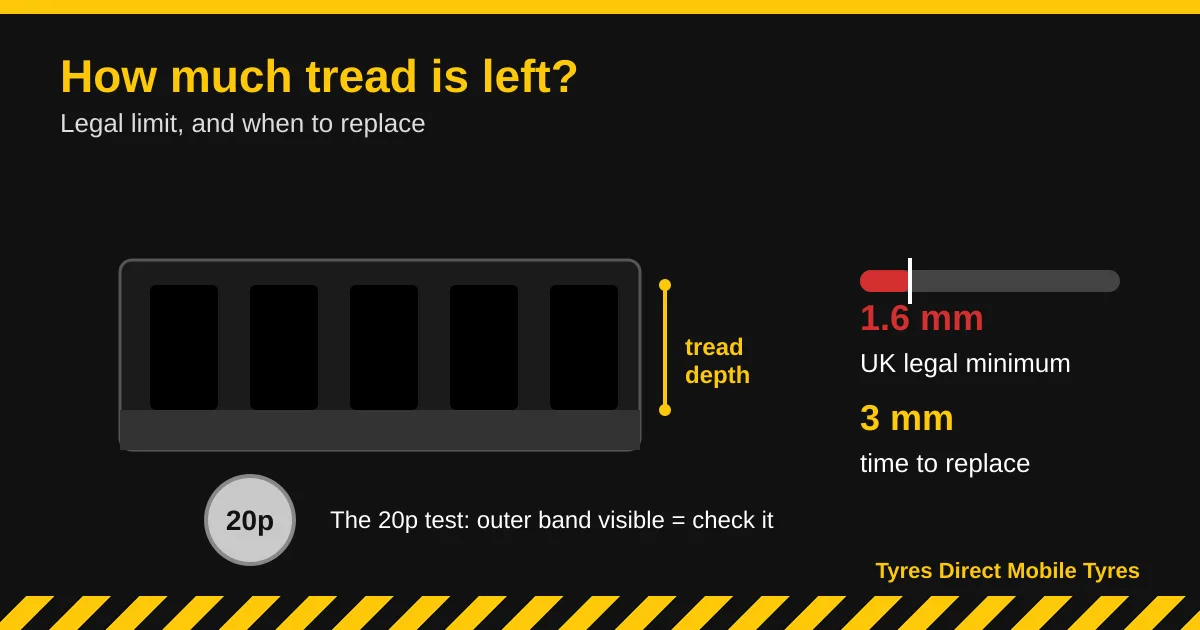
The legal minimum tread depth for most car tyres in the UK is 1.6mm across the central three-quarters of the tyre and around its entire circumference.
You can perform a quick initial check using a 20p coin. Insert the coin into several of the main tread grooves. If the outer border of the coin remains visible, the tread may be too low and should be professionally inspected.
For more information about tread depth, pressure and general vehicle safety, read the official UK Government vehicle safety guidance.
2. You Can See Cracks or Cuts
Examine the sidewalls of your tyres for visible cracking, deep cuts or signs of deterioration. Rubber can become less flexible over time, especially when a vehicle is frequently exposed to sunlight, changing temperatures or long periods without use.
Small surface marks may not always mean that a tyre needs immediate replacement. However, deep cracks, exposed cords or cuts should be assessed by an experienced tyre technician.
Do not continue driving if the tyre appears badly damaged or its internal structure is visible. Arrange a professional inspection before using the vehicle again.
3. There Is a Bulge in the Sidewall
A lump, bubble or bulge in the tyre’s sidewall can indicate that its internal structure has been damaged. This may happen after hitting a pothole, mounting a kerb or driving over road debris.
A tyre with a sidewall bulge can fail without warning and should not be ignored. Sidewall damage generally cannot be safely repaired, so the affected tyre will normally need to be replaced.
If you notice a bulge while your vehicle is parked, avoid driving it to a garage. A professional mobile tyre replacement service can come to your location and replace the damaged tyre on-site.
4. Your Vehicle Is Vibrating While Driving
Unusual vibration through the steering wheel or vehicle body can have several causes. These may include incorrect wheel balancing, uneven tyre wear, wheel damage or a problem with the vehicle’s steering or suspension.
If the vibration begins after hitting a pothole or kerb, inspect the tyres as soon as it is safe to do so. Look for visible damage, low pressure or an unusual change in the tyre’s shape.
Persistent vibration should always be professionally investigated. Continuing to drive could cause further tyre wear and make the vehicle more difficult to control.
5. Your Tyres Are Wearing Unevenly
Tyres should wear relatively evenly across their tread. Wear that is concentrated on one edge, in the centre or in isolated areas may indicate another problem.
Common causes of uneven tyre wear include:
- Incorrect tyre pressure
- Poor wheel alignment
- Unbalanced wheels
- Worn suspension components
- Frequent harsh braking or cornering
Replacing the worn tyre may be necessary, but it is also important to identify the underlying cause. Otherwise, the replacement tyre may begin wearing unevenly too.
6. Your Tyre Keeps Losing Pressure
A tyre that repeatedly needs inflating may have a slow puncture, damaged valve or poor seal around the wheel rim. Changes in temperature can affect tyre pressure, but frequent or significant pressure loss requires attention.
Check your tyre pressures when the tyres are cold and use the figures recommended by the vehicle manufacturer. These can usually be found in the owner’s handbook, inside the driver’s door or inside the fuel flap.
Read our guide on how to check your tyre pressure for a simple step-by-step explanation.
The UK Government advises drivers to regularly check that their vehicles are safe and roadworthy. A vehicle can still be unsafe even when it has a valid MOT certificate. You can read more on the official vehicle roadworthiness guidance page.
If one tyre continues losing air, have it inspected rather than repeatedly topping it up. A technician can determine whether it can be repaired or needs replacing.
7. The Tyre Has Suffered a Puncture or Impact
A nail or screw in the tread does not automatically mean that a tyre must be replaced. Some punctures within the central tread area may be repairable, depending on their size, position and the condition of the tyre.
Replacement is more likely to be required when:
- The puncture is in or close to the sidewall.
- The tyre has been driven while flat.
- The internal structure has been damaged.
- The tyre has already received an unsuitable repair.
- The remaining tread is excessively worn.
- There are multiple areas of damage.
Do not remove an embedded object yourself because it may be temporarily slowing the loss of air. Leave it in place and arrange for the tyre to be professionally inspected.
Our guide explaining whether a punctured tyre can be repaired provides more information about safe repairs and tyre replacement.
Should You Replace One Tyre or Two?
Whether you need to replace one or more tyres depends on the condition of the other tyres, the vehicle type and the manufacturer’s recommendations.
The tyres fitted across the same axle should have compatible specifications and similar performance characteristics. A technician can compare the tread depth and condition of the tyres before recommending the safest option.
Always make sure any replacement has the correct size, load rating and speed rating for your vehicle.
How Mobile Tyre Fitting Makes Replacement Easier
Driving to a garage with a damaged or underinflated tyre could make the problem worse. Mobile tyre fitting removes that risk by bringing the necessary equipment and replacement tyres directly to your location.
Mobile fitting is a convenient option when your vehicle is:
- Parked on your driveway
- At your workplace
- Stranded at the roadside
- In a car park
- Unsafe to drive to a garage
When requesting a quote, provide your vehicle registration, tyre size, location and contact number. If you cannot find the tyre size safely, the team can help identify the appropriate options from your registration.
Book Mobile Tyre Fitting in Poole or Bournemouth
If you have noticed low tread, cracking, pressure loss or visible damage, do not wait for the tyre to fail completely.
Tyres Direct Mobile Tyres provides fast and reliable mobile tyre fitting across Poole, Bournemouth, Dorset and the surrounding areas. Our technicians come directly to your home, workplace or roadside location to fit and balance your tyres on-site.
Contact Tyres Direct Mobile Tyres today with your registration, tyre size and location to request a clear quote.